

Stop posting and start operating with a strategy.
There is so much digital noise out there.
Imagine you are in a room full of people chatting and laughing. You start joining in, sharing your thoughts, but no one turns around.
That’s what the digital world has turned into.

A crowded room where everyone is talking and no one is listening. It’s overwhelming, and following every conversation or topic feels impossible.
So how do you change it?
You need time, effort and consistency to make this work. But more importantly, you need a plan.
A plan focused on topics your customers actually care about, content that helps them do their job better, make decisions more confidently, and solve problems. A plan that links into your company values and builds recognition instead of adding to the noise.
For example, if you are selling a service and want to be known as experts in your field, prove it. Get your subject matter experts involved. Craft a message that tells your company’s story. Address your customers’ pain points and explain clearly how you can solve them, how you make their lives easier with your service or product.
Content doesn’t fail because of quality; it fails because it lacks planning.
There are various ways of pulling a content plan together, but the SOSTAC® model by PR Smith, is a strategic planning framework used in professional marketing.
Without a plan, content becomes a random activity.
Let’s break it down…
A practical framework for B2B SMEs who want results, not random posts. Enter SOSTAC®
Situation analysis (Where are you now?)
Firstly, pause your posting schedule; this will work in your favour in the long run. Then review your:
- Current content performance
- Engagement levels
- Reach
- Website analytics
- Social media performance
- Reviews and comments
- What customers actually say about you
Not the vanity metrics. The meaningful ones.
Then ask yourself these questions; they will guide the rest of your planning:
- What are you known for?
- Is it attracting the right audience?
- What topics are generating the most engagement?
- Are you consistent?
Understanding where you are will help you understand where you want to go.
Read our LinkedIn Post for more details on vanity metrics.
Objectives (What are you trying to achieve?)
Ask yourself:
- What do you want to be known for?
- What business goal does this content support? (driving more leads? nurturing existing ones? creating awareness?)
More visibility is not an objective; make it specific and measurable:
- Increase website traffic to X
- Generate X leads per month
- Improve LinkedIn engagement to X
Content without an objective is just distributing.
Strategy (How will you achieve the objective?)
This is where your content themes come in. Choose a topic and run with it for 4-5 weeks. Align these with your company values and build authority around it.
For example, if you are a recruitment agency, you could focus on ‘Reducing hiring risk for SMEs’ and build content around workforce planning, improving candidate quality, shortening time to hire and strengthening retention.
Strategy is all about focus. When you cover too many topics, you weaken your brand and dilute your positioning. You’ll be another voice in the crowded room, talking louder but saying less.
Now map your content to the customer journey:
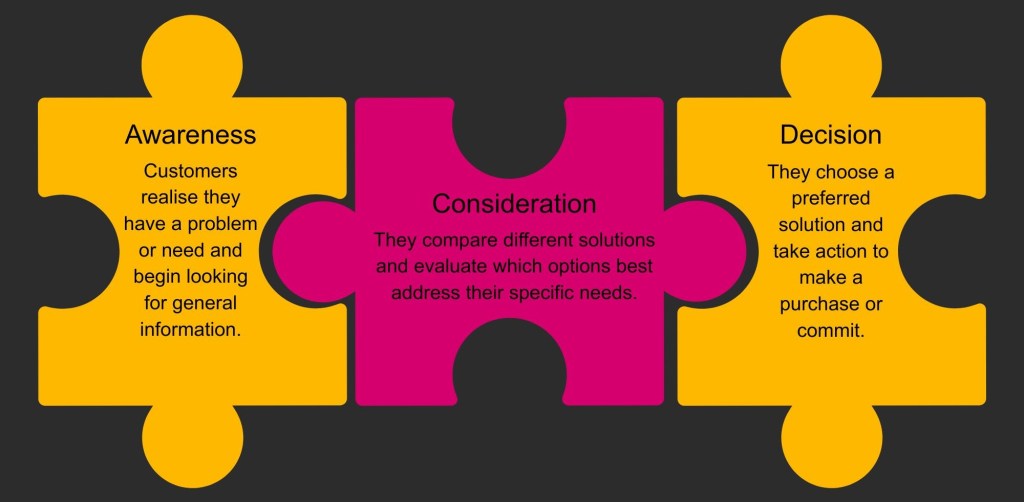
Tactics (What exactly will you do?)
This is the practical bit.
Articles, blogs, email, newsletters, paid ads, PPC, gated downloads, webinars, social posts, thought leadership, case studies and more…
Write one strong, in-depth blog post on a topic your customers genuinely care about. Something that helps them do their job better. Something that demonstrates your expertise.
Then repurpose it into:
- A carousel
- A short form social media post
- A video
- A newsletter
- A downloadable checklist
- A PDF infographic
- A sales enablement piece
Then distribute it to your contacts. Publish the blog on your website and social media with clear, strong hooks and calls to action. Then talk about it over the next five weeks. Pull sections out, add your company’s viewpoint and get your team involved in sharing and discussing it.
That’s how you build your network exposure, engagement and growth.
If your starting from scratch, you need to test and learn (a topic for another day). Marketing is part science and part experimental. Drop us an email at hello@luminamarketing.co.uk and we’ll happily talk you through it.
Action (Who does what and when?)
Plans fail without ownership.
Make sure you have:
- Budget
- Capacity
- Clear responsibility
Who writes the content? Who signs it off? How often will it be distributed?
Create a Gantt chart to map out timelines. Use a RACI matrix if you have a larger team, to highlight who is responsible for each task. Diarise time with your sales team to ensure alignment and buy-in.
Build a drumbeat of content; if you disappear for weeks, momentum drops and the algorithms and people lose interest.
Control (How do you measure and optimise?)
If you don’t define what success looks like, you can’t optimise performance.
Track meaningful results (make sure they feed into your objectives):
- Leads generated
- Conversion rates
- Time on page
- Enquiries
- Click Through Rates
- Impressions
Use qualitative feedback too:
- Social media surveys
- Net Promoter Score (NPS)
- Customer Satisfaction (CSAT)
- Direct customer conversations (online and offline)
The metrics you prioritise will depend on your business objectives.
Closing
The digital world is noisy, and the solution isn’t shouting louder, it’s planning smarter.
And yes, stepping away from the screen helps. Don’t forget to take a break and get some fresh air between planning; that’s usually when the best ideas emerge.
Looking for a more structured way to deliver your content?
Lumina Marketing offers a free 20 minute marketing review.
During the call, we will:
- Look at your current marketing approach
- Highlight quick wins
- Suggest practical improvements tailored to your goals
There is no obligation to sign up, just honest advice and clear direction.
Book a free digital audit here:
www.luminamarketing.co.uk/contact-us
Source: PR Smith (sostac.org).
 Lumina Marketing